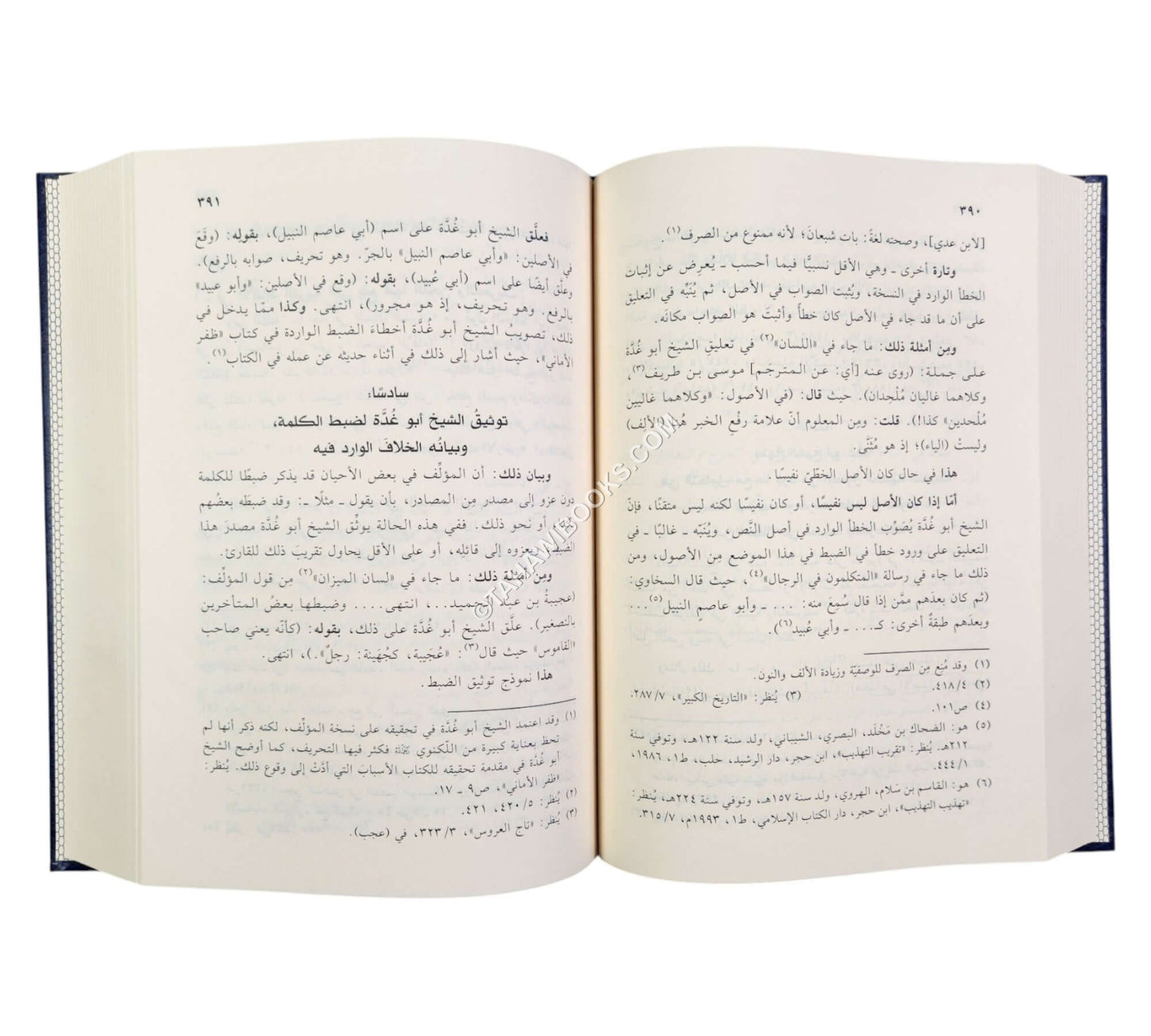
Shaykh ʿAbd al-Fattāḥ Abū Ghuddah and His Methodology in the Critical Editing and Publication of Texts
الشيخ عبد الفتاح أبو غدة ومنهجه في تحقيق النصوص ونشرها
This extensive academic study examines the life and scholarly legacy of the renowned Syrian scholar Shaykh ʿAbd al-Fattāḥ Abū Ghuddah, with particular emphasis on his distinctive methodology in the critical editing (taḥqīq), preparation, and publication of classical Islamic texts. Its principal objective is to reconstruct Abū Ghuddah’s practical approach to textual scholarship from his numerous editions and publications, identifying the principles and procedures he followed before, during, and after the process of editing a work.
The opening section presents a detailed biography of Abū Ghuddah, tracing his family background, upbringing, education, teachers, marriage and family, teaching, daʿwah activities, public service, scholarly travels, personal qualities, and death. It then surveys his exceptionally rich scholarly legacy, including his original writings, critical editions, publications, articles and research, introductions to other works, and projects which he intended or encouraged others to complete. Particular attention is given to the manuscript exemplars upon which his editions were based and to the bibliographical history and motivations behind his publication of works from the Islamic scholarly heritage.
The central portion of the book is a detailed study of Abū Ghuddah’s methodology as a muḥaqqiq. The author divides the editing process into three broad stages. The first concerns the work before actual textual editing begins: selecting a text worthy of publication, locating and assembling manuscript copies, evaluating and describing those manuscripts, determining the title of the work and the identity of its author, and establishing the authenticity of its attribution. The study considers Abū Ghuddah’s use of manuscript as well as printed sources and discusses his criteria for selecting manuscripts and establishing a reliable textual basis.
The second stage examines his methodology during the actual process of editing and establishing the text. Among the subjects treated are his transcription of manuscripts, comparison of variant copies, correction of scribal errors, treatment of omissions, additions and textual corruption, and his principles for choosing between variant readings. Separate attention is devoted to his exceptional precision in ضبط النص: vocalizing difficult words, verifying the spelling and pronunciation of the names of scholars, genealogical affiliations and place-names, and consulting authoritative sources to establish correct readings. The study also examines his organization of the text into paragraphs, identification of quotations, numbering of aḥādīth and other material, and his methods of documenting quotations and scholarly statements.
A further major section studies what Abū Ghuddah regarded as the complementary work of textual editing after the text itself had been established. This includes preparing scholarly introductions, studying the author and the work, producing detailed indexes (kashshāfāt), compiling bibliographies and lists of sources, recording information concerning editions and printings, and adding later corrections, supplementary notes, newly discovered material, documents and correspondence. His concern with the physical presentation of books is also examined, including typography, page layout and other aspects of book production, showing that for Abū Ghuddah the responsibility of the editor extended beyond reconstructing the wording of a text to presenting it in the most accurate and useful form possible.
Throughout, the author does not merely describe Abū Ghuddah’s principles theoretically, but documents them with examples drawn from his actual editions and with statements from Abū Ghuddah himself, while also offering critical observations where aspects of his practice may be questioned or refined. The study is supplemented by reproductions of documents and photographs relating to the Shaykh, as well as specimens of manuscript pages discussed in the research.
The result is both a substantial study of ʿAbd al-Fattāḥ Abū Ghuddah as a scholar and editor and a detailed examination of the craft of Arabic-Islamic textual criticism as he practised it. It highlights the extraordinary care he devoted to manuscripts, textual variants, names, references, documentation, annotation and the final presentation of scholarly books, making the work particularly valuable for students and researchers interested in taḥqīq al-nuṣūṣ, manuscript studies, Islamic bibliography, and the modern publication of the classical Islamic scholarly heritage.