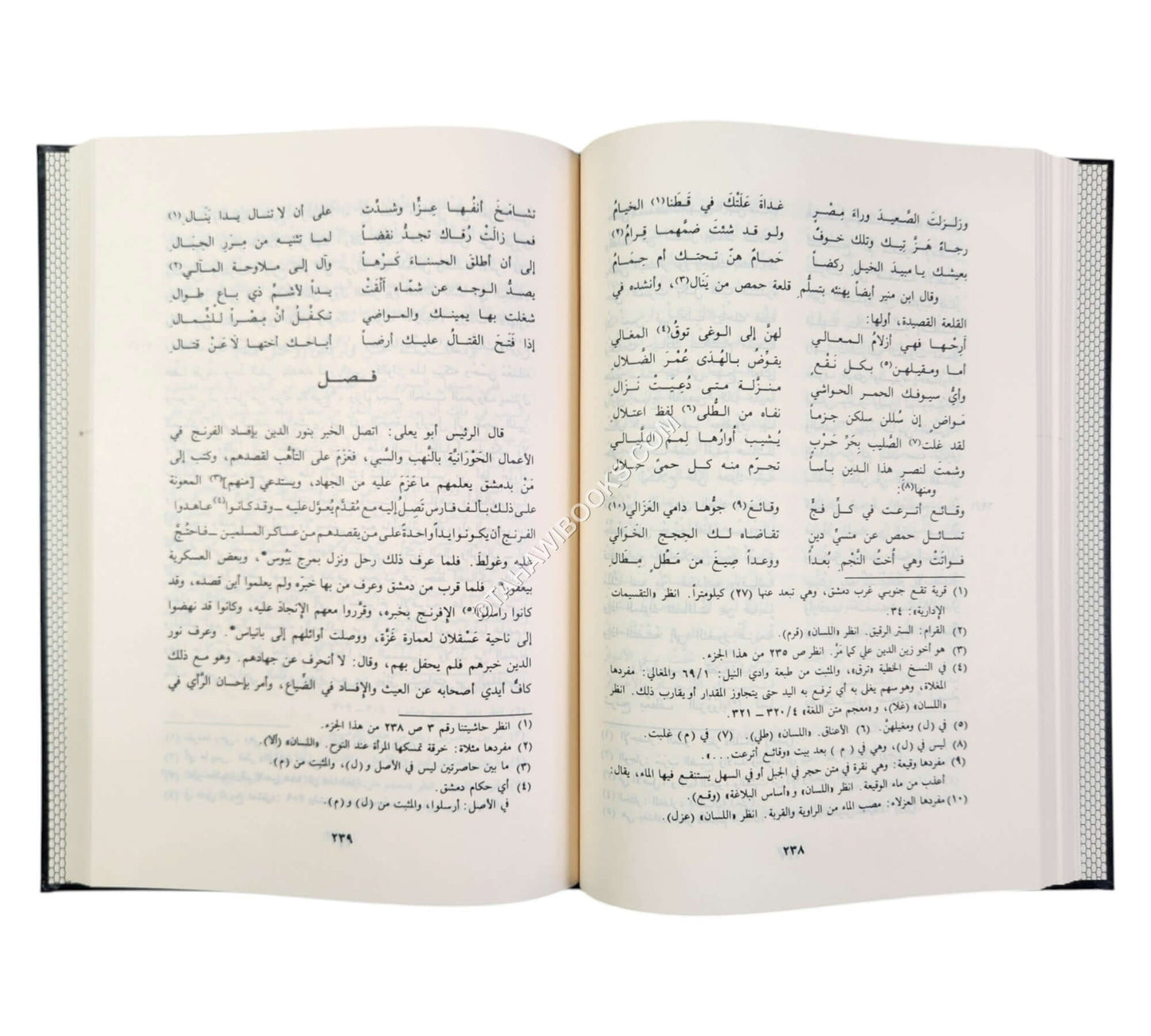
Instead of trying to put the value and relevance of this book into my own words, here is the translation of the words of the muhaqqiq:
“The book al-Rawḍatayn fī Akhbār al-Dawlatayn by Abū Shāmah is regarded as one of the most important and celebrated works dealing with the states of Nūr al-Dīn and Ṣalāḥ al-Dīn and their struggle against the Crusaders. Abū Shāmah distinguished this work by adopting a clear and sound methodology and displaying a remarkable historical sense in comparing the material of his sources and bringing their accounts together, as though they were the pieces of a single harmonious garment.
In my view, what made the book al-Rawḍatayn pulsate with the spirit of history was the clear intellectual position of its author, which manifested itself in his choice of the title Kitāb al-Rawḍatayn. Abū Shāmah, who almost lived to see the age of Ṣalāḥ al-Dīn, lived in a turbulent period in which brothers fought one another, seeking assistance in their struggles for power. He saw in the two states of Nūr al-Dīn and Ṣalāḥ al-Dīn two gardens amid the vast desert of this all-encompassing disorder.
Indeed, distressed by the age in which he lived, he sensed that there was a certain resemblance between ʿUmar ibn al-Khaṭṭāb and ʿUmar ibn ʿAbd al-ʿAzīz, on the one hand, and Nūr al-Dīn and Ṣalāḥ al-Dīn, on the other. He was therefore moved to compose this book in response to an inward yearning for justice and stability, addressing the rulers of his own age—and of every age—as though to say:
“I have written for you about two eras whose passing you lament and whose times you long for, yet you are incapable of resembling them; about two good rulers from your own age, both of whom were among the kings of your time, yet you have failed—and will continue to fail—to resemble them.”
Thus, Abū Shāmah did not write his history in order to present it to the sultan in the hope of receiving favour or reward. Rather, he wrote it as a practical methodology for administration under the rule of two just kings. Hence his book possesses this magnificent consistency and tightly constructed composition, and achieves a balance between the particular and the general—to the limits of its expression—in one of the greatest historical compendia of Damascus, the Umayyad capital, a work read by the people.
And just as Abū Shāmah embarked upon the composition of his book from a clear intellectual standpoint, he proceeded from that same standpoint in producing the book itself with meticulous scholarly precision.
It is therefore appropriate for us, now that we are in the midst of the Zionist conflict, to write about the Crusades—particularly because of the close resemblance between the struggle against the Crusaders and the Zionists...
We are presenting researchers with texts specifically concerning that period whose authenticity they can be confident of, so that their studies may be based upon sound scholarly foundations. Those who believe in the saying, “History repeats itself,” can benefit from our history in our present struggle against Zionism. In my view, however, history does not repeat itself in its entirety: every age has its own circumstances and conditions. Nevertheless, every age contains constants and variables: constants that we encounter in this age as we do in others, and variables that we see in it which differ from those of other ages. If we are able to identify the constants recorded for us by the books of our forefathers concerning the Crusaders, then we will have placed our feet upon the first step on the road to liberation...
The Zionists themselves recognise this resemblance between their occupation of our land and the Crusaders’ occupation of it in the past. They expect their state to meet the same fate as the Crusader kingdom, and they are therefore making strenuous efforts to avoid an end like that of Ḥiṭṭīn and what followed it. An entire research team at the Hebrew University has devoted itself to specialising in this subject.
Why, then, should we not benefit from our own history by identifying these constants, so that we might bring about another Ḥiṭṭīn?”
This is the best print of the book, edited using multiple manuscripts.
📘High-quality edition in 5 volumes.