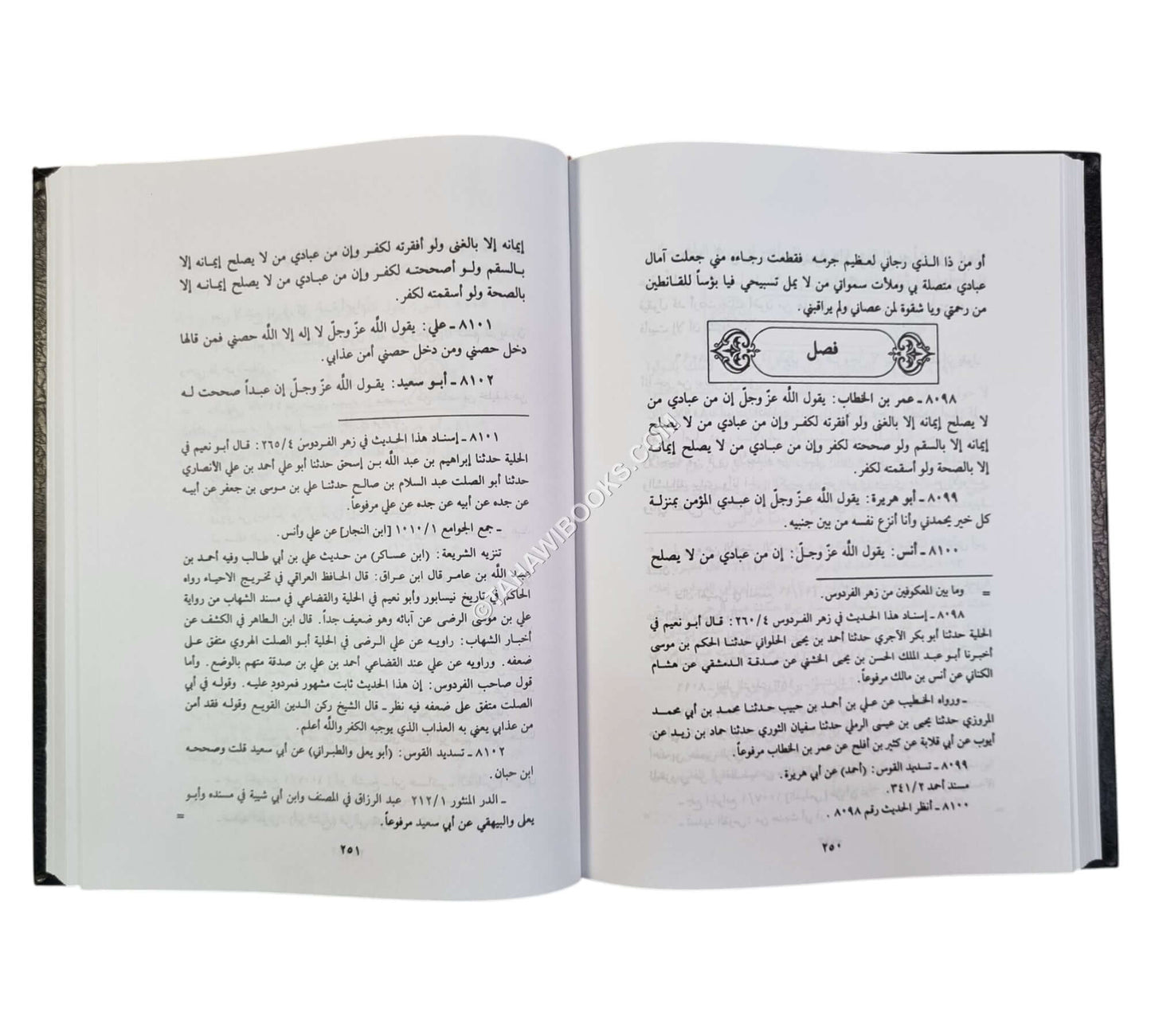
فردوس الفردوس وهو (الفردوس بأثور الخطاب) مع الفهارس
Musnad al-Firdaws
أبو شجاع شيرويه بن شهردار الديلمي
874
9057
A vast collection of Prophetic traditions compiled by the Ḥadīth scholar Abū Shujāʿ Shīrawayh ibn Shahradār al-Daylamī al-Hamadhānī (445–509 AH). Better known by its original title, al-Firdaws bi-Maʾthūr al-Khiṭāb, it is an unusual and valuable example of the large encyclopaedic collections designed to make the words of the Prophet ﷺ readily accessible by arranging them according to their opening words rather than according to legal chapters or Companion narrators.
Al-Daylamī gathered an exceptionally large body of material—this edition contains over 9,000 numbered reports—and arranged the traditions alphabetically according to their opening words. Thus, rather than searching under chapters of purification, prayer or transactions, the reader can locate a ḥadīth by the beginning of its text. The author generally gives the name of the Companion who transmitted the report and employs abbreviations indicating earlier sources from which it was taken.
A particularly important feature of al-Firdaws is that al-Daylamī deliberately omitted the full isnāds in order to produce a more manageable reference work for consultation. This distinguishes it from the related Musnad al-Firdaws compiled by his son, Abū Manṣūr Shahradār ibn Shīrawayh al-Daylamī (d. 558 AH), who transmitted the material with its chains. The title used on the Dār al-Kutub al-ʿIlmiyyah edition—Musnad al-Firdaws wa-huwa al-Firdaws bi-Maʾthūr al-Khiṭāb—can therefore cause some confusion: the text published here is the father's al-Firdaws bi-Maʾthūr al-Khiṭāb, whose original arrangement is largely without full isnāds. The publisher itself explicitly describes the author as having stripped the collection of its chains to facilitate consultation.
The collection is especially significant because it preserves a very wide range of material drawn from earlier Ḥadīth literature, including reports that became widely cited in later compilations. It was used extensively by subsequent scholars, and references to al-Firdaws and its Musnad occur frequently in works such as al-Suyūṭī's al-Jāmiʿ al-Kabīr, al-Muttaqī al-Hindī's Kanz al-ʿUmmāl and al-Munāwī's Fayḍ al-Qadīr. Its breadth makes it a useful resource for takhrīj and tracing less commonly transmitted narrations.
At the same time, al-Firdaws should not be treated as a collection restricted to authentic aḥādīth. It contains reports of widely varying strength, including weak and very weak material, and the author's inclusion of a narration does not itself constitute authentication. Its principal value is therefore as a large repository and reference source from which individual reports may be traced and then subjected to the normal methods of Ḥadīth criticism.
|
عنوان |
فردوس الفردوس وهو (الفردوس بأثور الخطاب) مع الفهارس |
|---|---|
|
مؤلف |
أبو شجاع شيرويه بن شهردار الديلمي |
|
المجلدات |
6 |
|
الناشر |
بيروت العلمية |
|
غطاء |
صعب |
|
الصفحات |
3024 |
|
أبعاد |
25×17×18 |
|
وزن |
5.405 |
|
محرر/مترجم |
السعيد بن بسيوني زغلول |
|
عام وفاة الكاتب |
509 |
|
جودة الطباعة |
طبعة بيروت عالية الجودة |
|
تشكيل/حركة |
تشكيل جزئي / حركة |
|
لون النص |
لون واحد |
|
Recommended Print |
Best/Good/Only Print |
|
Content |
|

R1,170.00