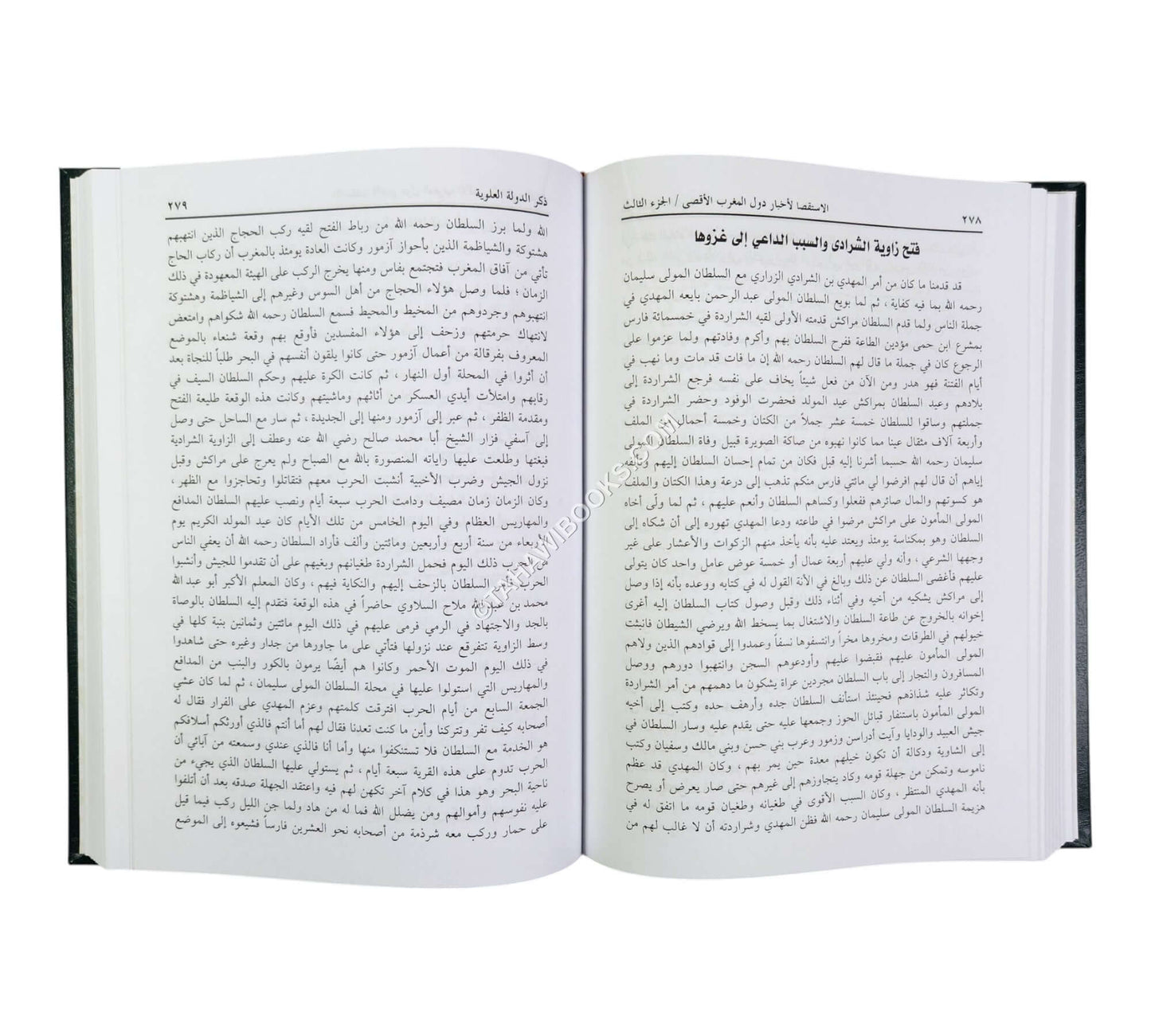
Al-Istiqṣā li-Akhbār Duwal al-Maghrib al-Aqṣā is one of the most comprehensive and authoritative classical histories of Morocco, authored by the distinguished Moroccan scholar, historian, and chronicler Abū al-ʿAbbās Aḥmad ibn Khālid al-Nāṣirī al-Salāwī (d. 1315 AH/1897 CE). The work traces the political and dynastic history of the far western Islamic world from the early Muslim conquests to the late nineteenth century, preserving an extraordinary wealth of information about the rulers, scholars, institutions, and historical developments that shaped Morocco over more than twelve centuries.
The work systematically examines the successive dynasties that ruled Morocco, beginning with the early Islamic period and the establishment of the Idrīsid state. It proceeds through the Maghrāwah and other regional powers, the Almoravids (al-Murābiṭūn), the Almohads (al-Muwaḥḥidūn), the Marīnids, the Waṭṭāsids, the Saʿdian dynasty, and the ʿAlawī dynasty, whose history extends into the author's own lifetime. The narrative encompasses the establishment and decline of ruling houses, succession disputes, military campaigns, political alliances, internal rebellions, and relations with neighbouring Muslim and European powers.
Although primarily a political history, the book extends well beyond the affairs of rulers and governments. Al-Nāṣirī records important developments in Moroccan society, including the activities of scholars and religious institutions, the influence of religious and intellectual movements, the establishment and development of cities, and the wider circumstances affecting the country's inhabitants. His accounts also provide valuable material concerning Morocco's relationships with al-Andalus, the central Maghrib, the Ottoman world, and European powers, particularly during periods of military confrontation and expanding European influence.
A particularly valuable feature of the work is the author's extensive use of earlier Moroccan and Andalusian historical sources, through which he preserves accounts of events and personalities from previous centuries. For the later periods, his proximity to the events described and his familiarity with Moroccan scholarly and political circles add further importance to the narrative. His combination of chronological history, dynastic biography, and historical commentary makes the work an indispensable resource for reconstructing the political and cultural development of Morocco.
Al-Nāṣirī was himself a prominent scholar associated with the intellectual traditions of Morocco, and his historical writing reflects a strong interest in the religious, political, and cultural identity of the country. His treatment of the ʿAlawī period is especially significant, offering detailed accounts of the reigns of successive sultans and the challenges confronting Morocco during an era of increasing European intervention.
This three-volume edition from Dār al-Kutub al-ʿIlmiyyah, Beirut, has been prepared by Muḥammad al-Sayyid ʿUthmān, presenting this monumental chronicle in a convenient format for scholars and readers.
An essential reference for students and researchers of Islamic history, Moroccan history, the history of the Maghrib, and Muslim–European relations, Al-Istiqṣā remains one of the foundational sources for understanding the historical development of Morocco and its place within the wider Islamic world.