لمحات في المكتبة والبحث والمصادر-مجلد
محمد عجاج الخطيب
3017
14386
Many of us are students in a Dar al-Ulum.
When undertaking this long course, what academic objectives do we have?
Is it just to attend lessons in class and gain a certificate?
If more than this, then we need to set down realistic goals and work at achieving them.
The same applies to ulama, who have graduated, but wish to further their studies.
Someone might feel that achieving mastery or at least competency in a certain field or fields is his goal. Another might wish to attain basic knowledge of every field.
I personally feel that a reasonable goal is to learn about each field to the extent that you have the ability to research and find out anything you wish in any field.
Thus, you should
-Know the books of tafsir/ulum al-quran well-enough to know where to find the answer to any question arising concerning the quran
-Be able to find any hadith and ascertain its strength
-know the workings and reliable books of each madhab well-enough to be able to find out the mu’tamad view in any madhab.
-know the books of lughah/nahw well enough to find the answer to a query in these fields.
The same for Tarikh, sirah, aqidah and every other field.
So, how does one build up this ability?
Ideally, one should study books authored as a madkhal to each of these fields. These books not only explain the workings of that field, but also discuss the various books in the field.
In addition to these madkhals, one could use a more general work, that would cover a host of different fields, with a concise introduction to each field and the major works in the field.
Unfortunately, good general works of this sort are very few.
This is one such work. It covers a host of different fields, with more detail on some fields than others. It is an indispensable tool, however it should be used in the correct manner, if one wishes to take full benefit.
How to use this book
Take a field at a time and after reading the intro to the field, read his write-up on a particular book. Then, find the book, either in a library or a pdf online and go through the book. If the muhaqqiq has discussed the manhaj and pros/cons in the dirasah, study this well.
Compare the contents of a chapter in this book, with the same chapter in another book in the field. This would allow you to understand the difference between the various works.
Try to memorise the title, authors name and the century he lived in.
And most importantly, make sure you refer to this book repeatedly.
Repeatedly using a book is the only way to ensure that you remember how the book works and its pros/cons.
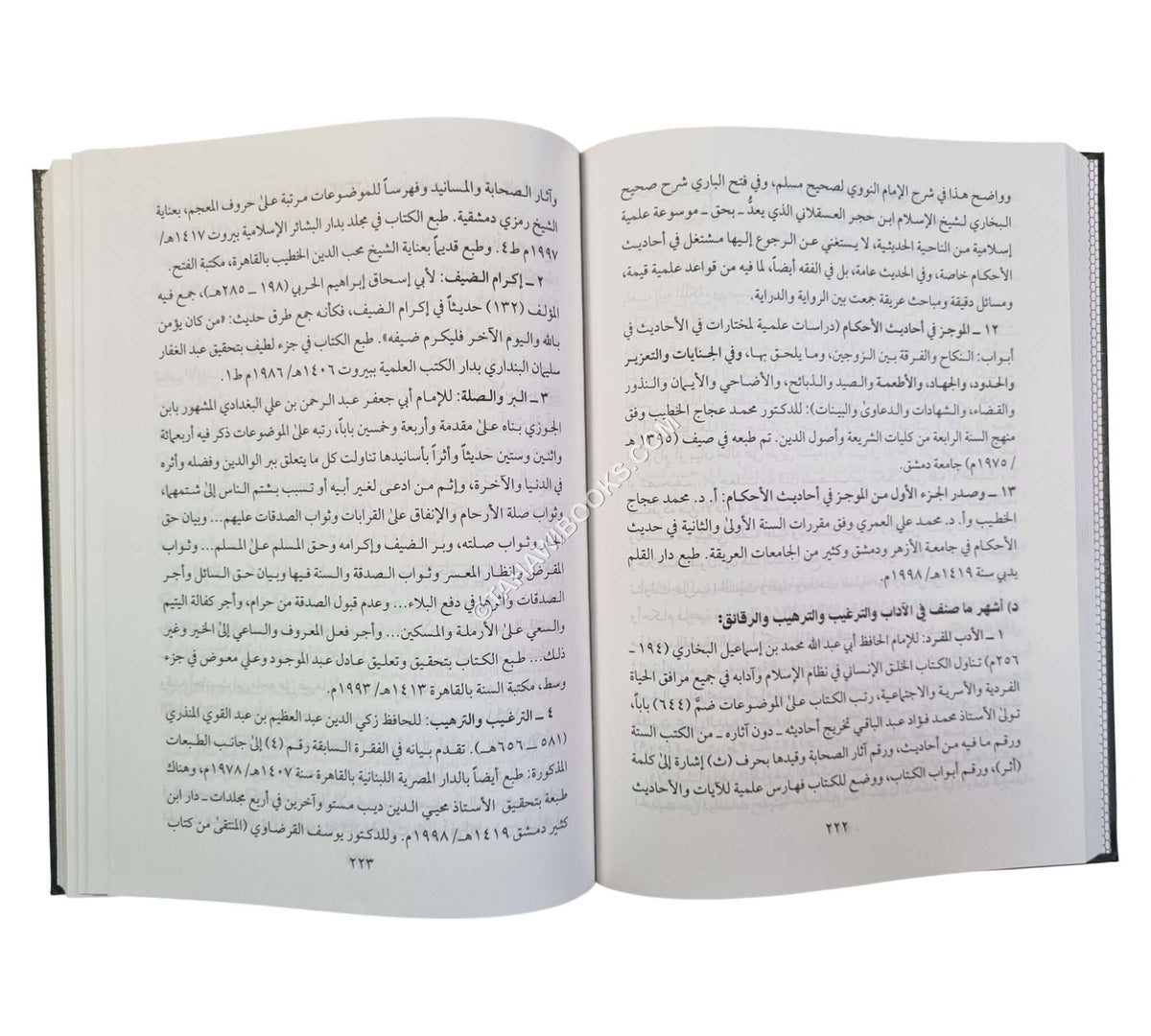
This book covers much more, including a study of the major Islamic Libraries, manuscript collections, how to use library indexes, the various stages of researching a topic etc.
Good-quality edition
|
Title |
لمحات في المكتبة والبحث والمصادر-مجلد |
|---|---|
|
Author |
محمد عجاج الخطيب |
|
Publisher |
الرسالة العالمية-بيروت |
|
Volumes |
1 |
|
Pages |
584 |
|
Cover |
Hard |
|
Weight |
1.1 |
|
Dimensions |
24x17x3 |
|
Publication Year |
2010 |
|
Print Quality |
Beirut High-Quality Edition |
|
Tashkil/Harakat |
Little to No Tashkil/Harakat |
|
Text Colour |
One Colour |
|
Recommended Print |
Best/Good/Only Print |
|
Content |
|

R295.00