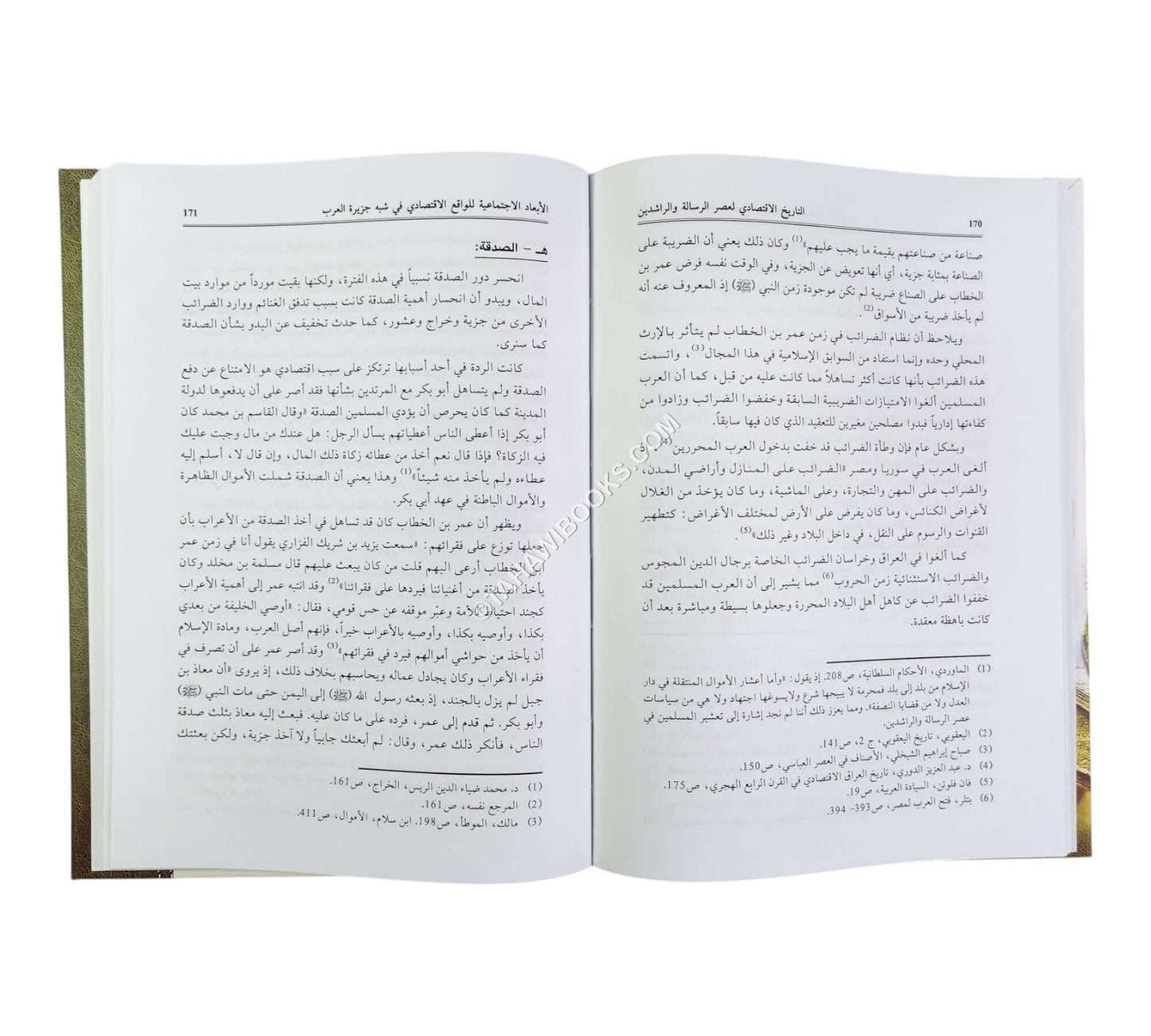
A fascinating academic study of the economic conditions, financial institutions and social transformations of the Muslim world during the lifetime of the Prophet Muḥammad ﷺ and the era of the Khulafāʾ al-Rāshidīn, written by the historian Dr Najmān Yāsīn al-Jubūrī.
While most works on the Sīrah and early Islamic history concentrate on political developments, military campaigns and the lives of prominent personalities, this book approaches the same historical period from a different and particularly illuminating perspective: How did people earn their livelihoods? What were the principal sources of wealth? How were land, trade and taxation organised? And how did economic developments influence the social and political circumstances of the early Muslim community?
The author explains in his introduction that a proper understanding of Islamic history cannot be achieved by studying political events in isolation from the economic and social conditions in which they occurred. His objective is therefore to reconstruct the economic circumstances of the formative Islamic period and demonstrate how developments in wealth, agriculture, commerce, taxation and social organisation contributed to the broader history of the Muslim Ummah.
The study begins with the economic life of Arabia before Islam, examining the influence of geography and the natural environment upon the lives of its inhabitants. The author investigates pastoralism and nomadic life, agriculture in regions such as Ṭāʾif and Yathrib, the development of agricultural landholdings in Yemen and the Ḥijāz, and the various industries and crafts practised by settled and nomadic communities.
Particular attention is given to trade and the commercial networks of pre-Islamic Arabia, including the role of merchants, the influence of commerce upon neighbouring civilisations, and the importance of markets in bringing together different Arabian communities. The author also examines the social consequences of economic inequality, including the distribution of wealth, class distinctions, slavery and the phenomenon of the Ṣaʿālīk—marginalised individuals and groups associated with the social and economic conditions of Arabian society.
The discussion then turns to the economic circumstances of Makkah, Ṭāʾif and Yathrib, providing the historical background necessary to understand the reforms introduced by Islam.
An important section examines the economic principles established by Islam, including the recognition that ultimate ownership belongs to Allah Taʿālā, the position of human beings as trustees over wealth, the recognition of individual ownership, the prohibition of Ribā, and the institutions of inheritance, charity, expiatory payments and the prohibition of hoarding wealth.
The author subsequently investigates the financial resources of the Islamic state during the Prophet's ﷺ lifetime, discussing Ghanāʾim (war booty), Jizyah and Zakāh, alongside the commercial and agricultural activities of the early Muslim community. He examines subjects such as the Prophet's ﷺ allocation of land, the leasing of agricultural land, the treatment of previously uncultivated land and the protection of designated areas through the institution of Ḥimā.
Of particular interest is the author's examination of the economic measures adopted by the Prophet ﷺ and their wider social and political implications. These include the establishment of Muʾākhāh (brotherhood) between the Muhājirīn and Anṣār, the treatment of inheritance, assistance provided to impoverished emigrants from the wealth of Banū al-Naḍīr, the material circumstances of those whose hearts were to be reconciled to Islam, and the financial arrangements involving the Arabian tribes.
The study then proceeds to the era of the Khulafāʾ al-Rāshidīn, examining the economic dimensions of the Wars of Riddah and the subsequent Muslim conquests. The author investigates how the expansion of Muslim rule transformed the financial resources of the Islamic state, with detailed discussions of Ghanāʾim, Jizyah, Kharāj, commercial duties and other sources of revenue.
A substantial portion is devoted to the economic reforms and developments that followed the conquests, including the administration of agricultural land, the conditions of cultivators, the establishment of the Dīwān and the system of stipends, the growth of trade and the development of urban centres in the newly incorporated territories. The author also discusses measures intended to regulate the movement of wealth and prevent the excessive outflow of gold and silver.
One of the book's most thought-provoking features is its investigation of the relationship between economic developments and the political tensions that emerged during the later Rāshidūn period.
The author examines the social and financial policies associated with Sayyidunā ʿUmar (raḍiyallāhu ʿanhu), including his measures concerning wealth and the conduct of governors, before turning to the expansion of agricultural and commercial investment during the caliphate of Sayyidunā ʿUthmān (raḍiyallāhu ʿanhu).
He explores the accumulation and distribution of wealth, the economic circumstances of governors and prominent individuals, the growth of trade and landownership, and the relationship between these developments and the political opposition that eventually arose. He also investigates the economic and social dimensions of the unrest during Sayyidunā ʿUthmān's caliphate, the tensions between central authority and tribal interests, and the economic circumstances during the caliphate of Sayyidunā ʿAlī (raḍiyallāhu ʿanhu).
The author further considers the economic significance of the transfer of the capital to Kūfah, the relationship between wealth and competing political tendencies, and the financial instability associated with the conflicts of the period.
Another particularly valuable aspect of this study is the author's research methodology and extensive use of early historical sources. As explained in his introduction, he does not rely solely upon conventional historical chronicles, but draws upon specialised classical works dealing with taxation, public finance and economic administration, including the Kitāb al-Kharāj literature of Abū Yūsuf, Ibn Ādam, Ibn Rajab and Abū ʿUbayd al-Qāsim ibn Sallām.
He also consults the historical writings of al-Ṭabarī, al-Yaʿqūbī and al-Masʿūdī, together with geographical works, biographical dictionaries, collections of Ḥadīth and other early sources containing valuable information about economic and social life. The author explains that these reports are scattered throughout numerous works and sometimes present conflicting accounts, requiring careful comparison and evaluation within their historical contexts.
His approach is therefore not merely descriptive. He attempts to analyse economic developments in relation to their social and political consequences, while also engaging critically with interpretations advanced by earlier historians, modern researchers and Orientalist scholars.
This makes the book especially valuable for readers interested in understanding the early Islamic period beyond its familiar political and military narratives. It provides a perspective on the economic foundations of the Islamic state, the administration of public wealth, the development of agricultural and commercial activity, and the complex relationship between financial conditions and historical events.
An important reference for advanced students and researchers of Islamic history, Sīrah, the Khulafāʾ al-Rāshidīn and the history of Islamic economic institutions. Its detailed treatment of economic life and its extensive use of classical historical and financial sources make it a particularly useful addition to a serious Islamic history library.