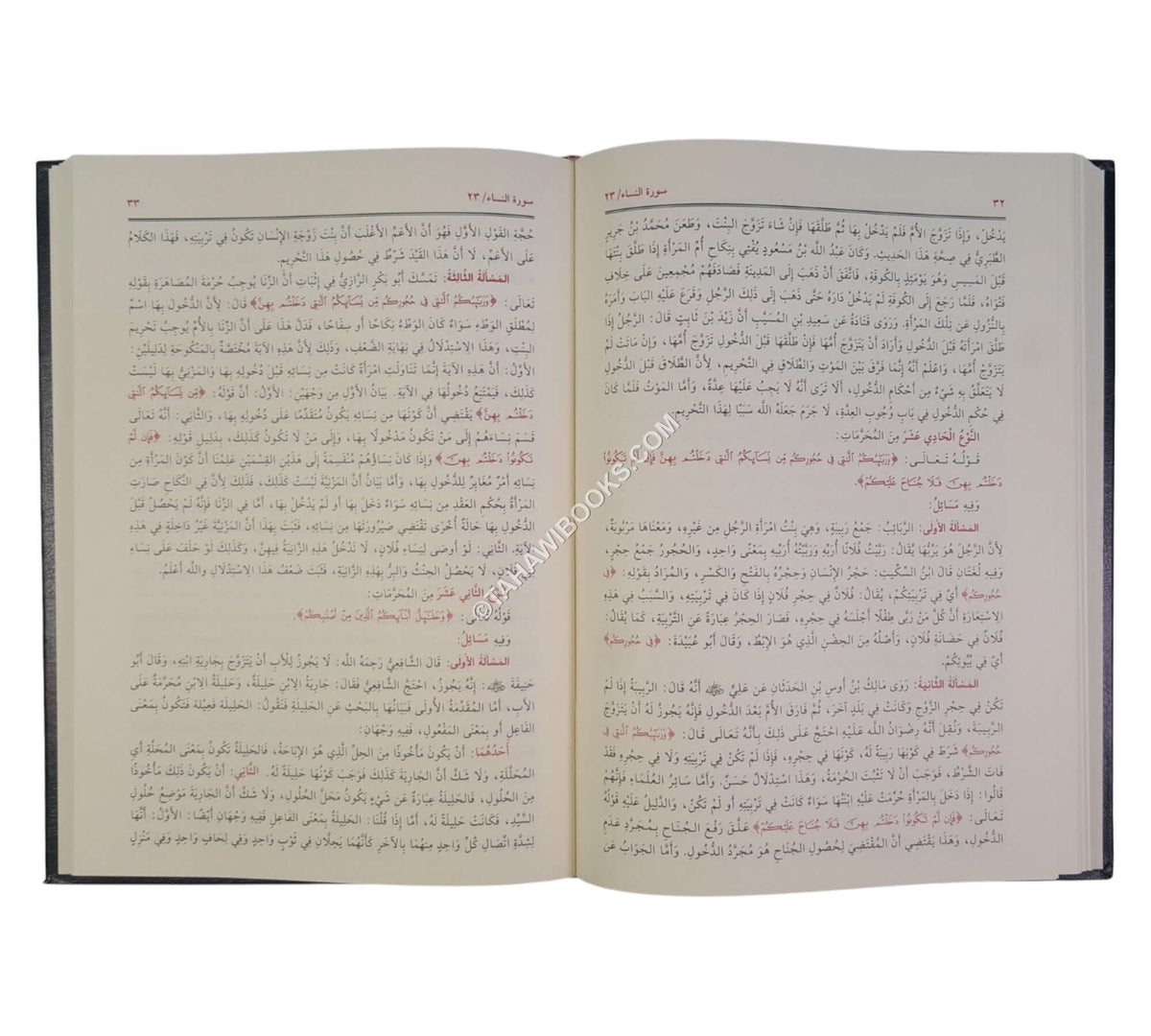
One of the most expansive and intellectually ambitious works of classical Qurʾānic commentary, authored by the celebrated Shāfiʿī theologian and polymath Fakhr al-Dīn Muḥammad ibn ʿUmar al-Rāzī (544–606 AH / 1150–1210 CE). Al-Rāzī was among the foremost scholars of his age, attaining distinction in Tafsīr, Kalām, Uṣūl al-Fiqh and Fiqh, while also possessing extensive knowledge of philosophy, logic, mathematics, medicine and the natural sciences. This extraordinary breadth of learning is reflected throughout his monumental tafsīr.
Mafātīḥ al-Ghayb, more commonly known as al-Tafsīr al-Kabīr, represents one of the outstanding examples of tafsīr bi’l-raʾy al-maḥmūd—reasoned interpretation grounded in the recognised disciplines of Islamic scholarship. Al-Rāzī sought not merely to explain the immediate meaning of the verses, but to uncover the extraordinary range of questions, arguments and intellectual insights that could be derived from them. His commentary consequently became encyclopaedic in scope, incorporating discussions of ʿAqīdah, Fiqh, Uṣūl, Arabic language, Qirāʾāt, philosophy, logic, Taṣawwuf, astronomy, medicine and the natural sciences within the framework of Qurʾānic interpretation.
A defining characteristic of al-Rāzī's method is his rigorous analytical and dialectical approach. Questions are frequently presented as masāʾil, followed by various possible arguments (wujūh), objections and responses. Rather than merely transmitting earlier interpretations, he subjects them to critical examination, compares their evidences and frequently advances his own preferred conclusion. Among his important exegetical sources were the views of the Ṣaḥābah and Tābiʿūn and the works of earlier mufassirūn such as al-Ṭabarī, al-Thaʿlabī, al-Wāḥidī and al-Zamakhsharī.
Particular attention is devoted to the linguistic and literary dimensions of the Qurʾān. Al-Rāzī examines vocabulary, word roots, grammar, iʿrāb and Balāghah, while exploring the wisdom underlying particular expressions and constructions. Especially noteworthy is his concern with naẓm and munāsabah: the relationship between words within a verse, between neighbouring verses, between individual passages and their sūrahs, and even between one sūrah and another. Through these discussions he seeks to demonstrate the remarkable coherence, precision and rhetorical inimitability of the Qurʾān.
The tafsīr is equally important for its extensive treatment of theology and intellectual argumentation. A master of debate, al-Rāzī presents opposing arguments—particularly those associated with the Muʿtazilah and the philosophers—often in considerable detail before responding to them from his own theological perspective. In legal passages he compares the opinions and proofs of the jurists; although a Shāfiʿī himself, he may prefer another position where he regards its evidence as stronger. Qirāʾāt likewise receive substantial attention, particularly the mutawātir readings and the differences in meaning or legal implication arising from them.
Another distinctive feature is al-Rāzī's willingness to draw upon the scientific and philosophical knowledge of his age when interpreting Qurʾānic references to creation and the natural world. For him, contemplation of the heavens and earth was integral to appreciating the Qurʾān's proofs of the Creator and His attributes. These discussions naturally reflect the scientific understanding available in the sixth/seventh Islamic centuries and therefore require critical evaluation by the modern reader, but they remain an important illustration of the remarkable intellectual scope al-Rāzī envisioned for Qurʾānic commentary.
The work exercised a profound influence upon later Tafsīr, with major mufassirūn such as al-Bayḍāwī, Abū Ḥayyān and al-Ālūsī drawing upon it. Questions have historically been raised over whether al-Rāzī completed the entire commentary himself, with some classical scholars attributing portions to later scholars such as al-Khuwayyī or al-Qāmūlī, while more recent research has argued that the whole work may in fact be attributable to al-Rāzī. Regardless of this authorship debate, Mafātīḥ al-Ghayb remains one of the great encyclopaedic monuments of the Tafsīr tradition, particularly valuable to advanced students interested in the intersection of Qurʾānic exegesis, theology, rational argument, language and the intellectual sciences.