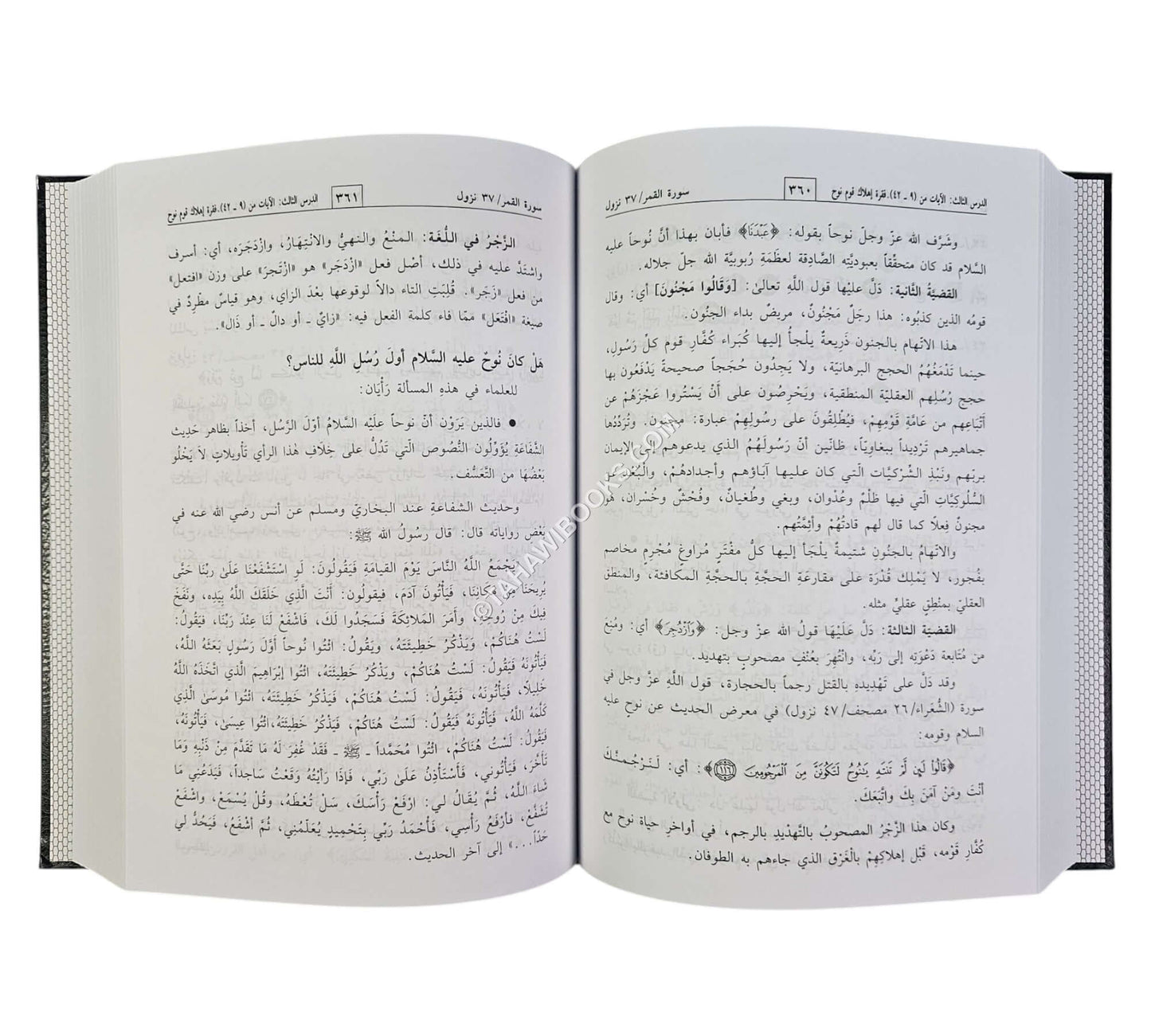
An exceptionally extensive contemporary Tafsīr by the Syrian scholar and thinker ʿAbd al-Raḥmān Ḥasan Ḥabannakah al-Maydānī (1345–1425 AH / 1927–2004 CE), distinguished above all by its unusual method of interpreting the Qurʾān according to the approximate chronological order in which the Sūrahs were revealed, rather than their familiar arrangement in the Muṣḥaf. The work was written as a practical application of the author's earlier methodological study, Qawāʿid al-Tadabbur al-Amthal li-Kitāb Allāh ʿAzza wa-Jall.
The purpose of adopting the order of revelation is not to propose an alternative arrangement of the Qurʾān for recitation, but to study the progressive development of the Qurʾānic message: how the Qurʾān educated the first Muslim community, established the foundations of faith, responded to changing circumstances, confronted objections, and gradually introduced its religious, moral and social teachings. Al-Maydānī therefore treats chronology as an important aid to understanding what he describes as the Qurʾān's movement of intellectual and religious formation.
The work begins accordingly with Sūrat al-ʿAlaq, followed by al-Muddaththir, al-Muzzammil, al-Qalam and other early Makkan revelations. Later volumes proceed through the developing Makkan period; volume 10, for example, covers Yūnus, Hūd and Yūsuf, while volumes 11–14 reach later Makkan Sūrahs including al-Anʿām, al-Ṣāffāt, Luqmān, al-Zumar, Ghāfir, Fuṣṣilat, al-Shūrā, al-Zukhruf, al-Kahf, al-Naḥl, Ibrāhīm and al-Anbiyāʾ.
This chronological arrangement is accompanied by al-Maydānī's characteristic method of tadabbur, or sustained reflective analysis. Rather than restricting himself to explaining individual words and verses, he seeks to identify the larger subjects, arguments and educational objectives of each Sūrah. Passages are divided into interconnected “lessons” (durūs), followed by detailed analytical reflection (al-tadabbur al-taḥlīlī). Attention is given to the relationship between passages, the progression of an argument, recurring Qurʾānic themes, rhetorical expression, language and the lessons that emerge from the text.
Despite its reflective character, this is not merely a devotional commentary. Al-Maydānī engages extensively with the established disciplines of Tafsīr, including Arabic language and usage, Balāghah, Qirāʾāt, circumstances and chronology of revelation, Prophetic Sīrah, earlier Tafsīr literature and the relationship between different Qurʾānic passages. The searchable text demonstrates repeated discussion of the canonical readers and their variant readings alongside linguistic and interpretive analysis.
One of the most interesting features of the project is that it remained unfinished. The published Maʿārij al-Tafakkur comprises 15 substantial volumes, but does not reach a complete Tafsīr of the Qurʾān. The fifteenth volume covers al-Nabaʾ, al-Nāziʿāt, al-Infiṭār, al-Inshiqāq, al-Rūm, al-ʿAnkabūt and al-Muṭaffifīn, and concludes with introductory material for Sūrat al-Baqarah. Thus, despite its enormous size, the work essentially reaches the threshold of the major Madinan phase rather than completing the Qurʾān.
This limitation also reveals something important about the character of the work: al-Maydānī was not attempting a brief chronological paraphrase, but an extremely detailed analytical Tafsīr, with some individual Sūrahs occupying very substantial portions of a volume or more. The surviving fifteen volumes therefore constitute a particularly rich study of the Makkan Qurʾān and the gradual formation of Qurʾānic belief, thought and character.
Published by Dār al-Qalam, Damascus, the complete published portion consists of 15 large hardback volumes. The work began appearing around 1420 AH / 2000 CE; a later Dār al-Qalam printing is recorded as 1433 AH / 2012 CE.
Maʿārij al-Tafakkur wa-Daqāʾiq al-Tadabbur is therefore particularly valuable for readers seeking a thematic, analytical and reflective approach to Tafsīr, and especially for those interested in following the Qurʾānic message through the successive stages of revelation and observing how its themes of Tawḥīd, Prophethood, the Hereafter, moral formation and the building of the Muslim community develop across the revelatory period.